explainer
Smart Scales: What They Measure Well, and What to Ignore
Your smart scale's weight reading is reliable. Its body-fat percentage is an estimate that moves with your hydration. How bioimpedance works, why daily readings jump, and how to use trends instead of single numbers.
Smart scales promise a lot from one step: weight, body-fat percentage, muscle mass, water, bone mass and sometimes a “metabolic age”. Some of that is solid. Some is an educated guess with a decimal point attached. If you use the scale to guide a diet or training block, knowing which numbers to trust saves you a lot of unnecessary worry.
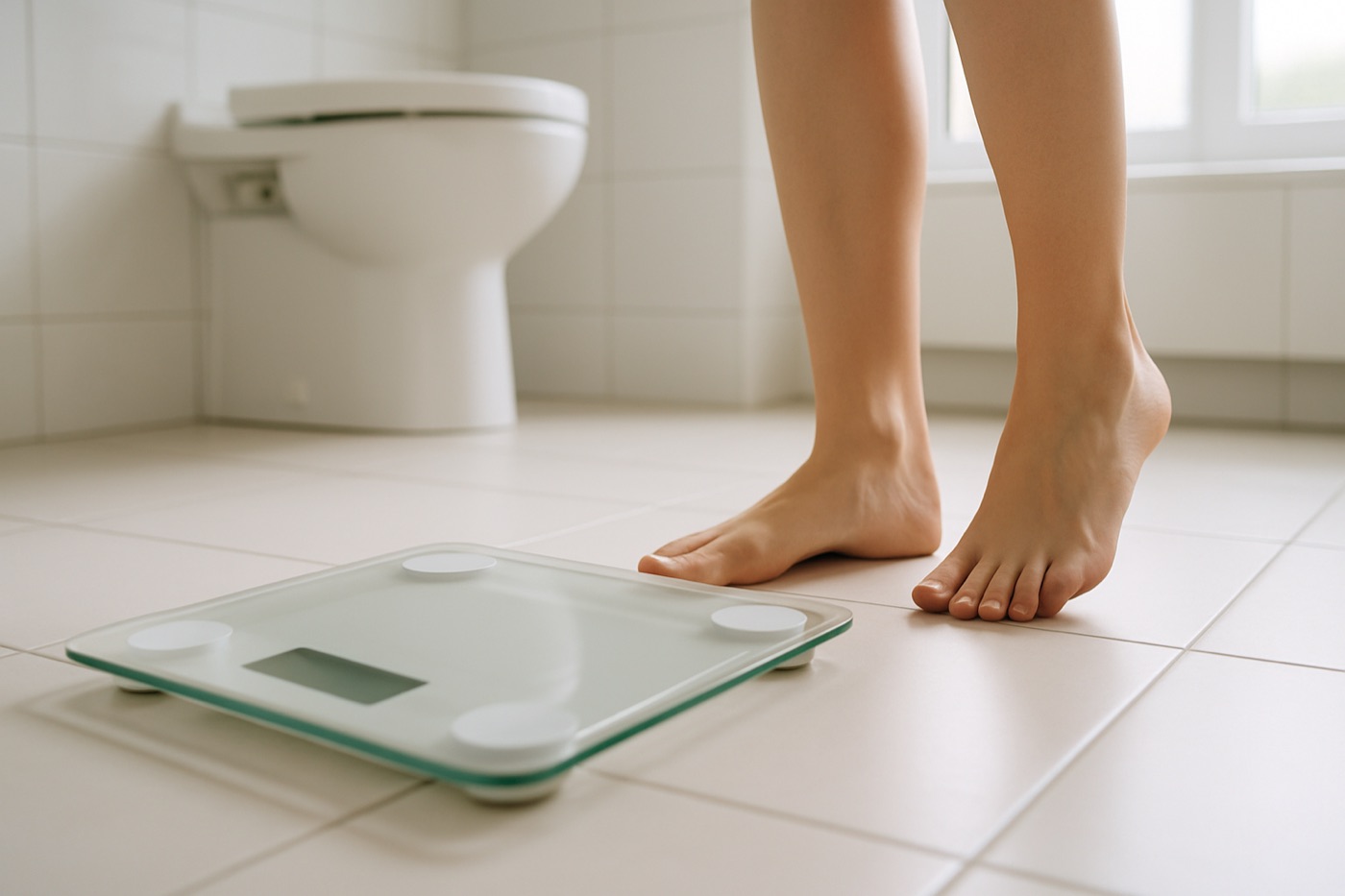
Weight is the number you can trust
Measuring weight is a solved problem. Any decent digital scale on a hard, flat floor gives a repeatable reading within a few tenths of a pound. Expensive smart scales don’t weigh you more accurately than cheap ones. What you pay for is the app, syncing and the body-composition estimates.
What makes weight confusing isn’t the scale — it’s your body. Day to day, your weight moves with water, glycogen (each gram is stored with water), salt intake, how much food is still in your gut and, for many women, the menstrual cycle. Swings of one to two percent of body weight between mornings are normal and have almost nothing to do with fat.
How the body-fat estimate works
Smart scales use bioelectrical impedance analysis (BIA). A tiny current passes through your feet, and the scale measures how much the body resists it. Lean tissue holds a lot of water and conducts well. Fat conducts poorly. The scale feeds that resistance, together with the height, age and sex you entered, into a prediction equation built from reference populations.
Two weak points follow. First, a scale that only touches your feet mostly measures your legs and lower body, then extrapolates to the rest of you. Second, anything that changes your hydration changes the reading. Weigh in dehydrated after a workout and your body fat “goes up”. Weigh in after a big, salty dinner and it “goes down”.
Compared with reference methods like DXA, consumer BIA scales can be off by several percentage points for an individual, and the error isn’t always in the same direction. Treat the body-fat number as a rough estimate, not a measurement.
Muscle, water, bone and “metabolic age”
These figures all come out of the same impedance reading and the same equations, so they share the same weaknesses. “Metabolic age” is a marketing number, not a clinical one. If a scale tells you that you gained a pound of muscle in a week while dieting, that’s water.

Use trends, not single readings
The most useful thing a smart scale does is make daily weighing effortless, and daily weighing is valuable when you look at averages:
- Weigh at the same time every day — first thing in the morning, after the bathroom, before food or water.
- Use a weekly average. Compare this week’s average with last week’s. That smooths out water noise.
- Expect a delay. A real change in fat takes one to two weeks to show clearly through the noise.
- Read body fat over months. If the estimate drifts down steadily over two or three months under the same conditions, that direction is meaningful even if the absolute number isn’t.
Many scale apps, and most nutrition apps, already show a smoothed trend line. Use it instead of the daily number.
What’s worth paying for
- Reliable syncing to the app you already use for nutrition or training, so the data ends up where you’ll actually look at it.
- Multi-user recognition, if you share a bathroom.
- A stable build and a flat base. Thin, flexible scales on bathroom mats give inconsistent readings.
Handheld electrodes, which run current through both arms and legs, can improve body-composition estimates a little. For most people, though, the extra features don’t change what they actually do with the data.
When you need better than a scale
If body composition really matters — for an athlete making weight, or a clinician tracking muscle loss — a DXA scan, ideally repeated at the same clinic under the same conditions, is far more reliable. Waist measurements and progress photos taken in the same light are cheap, underrated ways to cross-check what the scale suggests.
The bottom line
Trust the weight, average it weekly, and treat body-fat percentage as a slow-moving estimate that’s easily nudged by water. A smart scale is a great tool for consistency. It isn’t a lab.
FAQ
Are smart scale body fat readings accurate?
Not very, in absolute terms. Consumer scales estimate body fat from electrical resistance, which shifts with hydration, recent meals and exercise. Compared with a lab method like DXA, readings can be off by several percentage points. They're more useful for spotting a direction of change over months than for a precise number.
Why does my weight change so much from day to day?
Water, glycogen, salt, food still in your gut and, for many women, the menstrual cycle. A swing of one to two percent of body weight between days is normal and says almost nothing about fat. Look at weekly averages instead.
When is the best time to weigh myself?
First thing in the morning, after using the bathroom and before eating or drinking, on the same scale on a hard, flat floor. Consistent conditions matter more than the time itself.